
The BCG Consulting Career Assessment is one of the earliest online tests many candidates face in the BCG recruiting process. It is not a full case interview, and it is not a recorded video interview. It is a short assessment that combines behavioral profiling with timed reasoning, so preparation should focus on both consistency and speed.
This guide explains the 2026 BCG CCA format, the likely question types, the timing rules, how the assessment differs from other BCG tests, and how you should prepare before opening the assessment link. Exact details can vary by role, office, and recruiting cycle, so always follow the instructions in your official invitation email.
Table of Contents:
- What is the BCG CCA?
- Where Does the BCG CCA Fit in the BCG Hiring Process?
- What Is the BCG CCA Format and Timing in 2026?
- What Question Types Are in the BCG CCA Numerical Reasoning Test?
- How Is the BCG CCA Scored and How Hard Is It?
- How Should You Prepare for the BCG Consulting Career Assessment?
- Frequently Asked Questions About the BCG CCA
TL;DR – BCG CCA in 60 seconds
- The BCG CCA is a 30 minute online assessment with two personality sections and one numerical reasoning section.
- Candidates typically receive 24 hours to complete it after invitation.
- The numerical section has 8 questions in 12 minutes, calculator use is allowed, and there is no camera or video component.
What Is the BCG Consulting Career Assessment?
The BCG Consulting Career Assessment is an early online screening test used to evaluate how candidates think, work, and respond under time pressure. In 2026, the BCG CCA combines personality questions with numerical reasoning, helping BCG assess consulting readiness before online cases and live interviews.
The assessment is designed to give BCG more information than a resume can provide. A strong resume shows experience, education, and achievements. The BCG CCA looks at how you behave in professional situations and how quickly you can structure information when the clock is running.
The test does not ask you to solve a full business case. It also does not require you to record a video answer. Instead, it uses three short sections to evaluate two broad areas.
- Professional behavior and work style, including communication, adaptability, teamwork, leadership, empathy, time management, and decision habits.
- Numerical and logical reasoning, including schedules, calculations, constraints, patterns, and visual sequences.
This means the BCG Consulting Career Assessment is not only about getting calculations right. BCG is trying to understand whether your overall profile fits the habits expected of a consultant. Good candidates are structured, self-aware, reliable under pressure, and consistent in how they describe their behavior.
The most common mistake is preparing for only one half of the test. Some candidates overprepare for math and treat the personality sections casually. Others focus on behavioral answers and underestimate the pace of the numerical section. You need both.
Kickstart Your Consulting Prep Journey?
Click the image below to get your free Consulting Starter Pack
.png)
Where Does the BCG CCA Fit in the BCG Hiring Process?
The BCG CCA usually appears early in the BCG hiring process, after the initial application review and before the online case and live interview rounds. Its purpose is to add a structured assessment layer that goes beyond resumes, cover letters, and prior experience.
In many recruiting processes, the CCA sits between the initial screening stage and the case interview stage. It can act as a filter before BCG invests time in the online case and live interviews. That makes it important even though it is shorter than a full consulting interview.
A typical process may include the following stages, although the exact order can vary by country, office, role, and cycle.
- Initial application review, including resume and cover letter review.
- Early online assessments, which may include tools such as the BCG CCA or other screening steps depending on the recruiting process.
- BCG online case assessment and first live interview, often including a case and personal experience component.
- Final round interviews, usually with additional case interviews and behavioral discussion.
- Offer decision.
The key point is simple: the BCG CCA is not a practice exercise. It can influence whether you move forward to the next stage. You should take it seriously, set aside focused time, and avoid opening the link until you are ready to finish the assessment in one sitting.
The CCA is also different from a case interview. A case interview tests your ability to structure business problems, ask questions, build a recommendation, and communicate with an interviewer. The CCA is more standardized. It gives BCG a comparable profile across candidates before the interview stage.
What Is the BCG CCA Format and Timing in 2026?
The BCG CCA format in 2026 includes two personality sections and one timed numerical reasoning section. The full assessment takes about 30 minutes, but only the numerical part is timed, with 8 questions in 12 minutes and calculator use allowed.
| Section | What it tests | Typical format | Timing |
|---|---|---|---|
| Personality Test 1 | Work style, values, and behavioral tendencies | 76 prompts with statement ranking | Not timed |
| Numerical Reasoning | Logic, scheduling, calculations, and patterns | 8 questions | 12 minutes |
| Personality Test 2 | How others may perceive your professional behavior | 15 prompts | Not timed |
Personality Test 1 usually presents groups of statements and asks you to choose which one describes you best at work. You may then compare the remaining statements and choose which is more like you. The goal is not to find a hidden perfect answer. The goal is to build a coherent behavioral profile.
The numerical reasoning section is the only part with strict time pressure. You have 12 minutes for 8 questions, which gives you about 90 seconds per question. Once you submit a numerical answer and move forward, you may not be able to return and change it. That makes pacing essential.
Personality Test 2 is shorter and focuses on how others may describe your professional behavior. Think of this section as an external view of the same profile. Your answers should not conflict sharply with the way you described yourself earlier.
Candidates typically receive a limited completion window after the invitation email, often 24 hours. Since the test takes about 30 minutes, the real challenge is not finding enough total time. The challenge is choosing the right 30 minute window, without interruptions, fatigue, or distractions.
Before you start, prepare three things: a reliable computer and internet connection, a calculator, and a notepad with pen. Use the notepad for schedules, constraints, and quick calculations. Do not rely on mental tracking for every rule in the numerical section.
What Question Types Are in the BCG CCA Numerical Reasoning Test?
The BCG CCA numerical reasoning test usually includes time reallocation, scheduling logic, quantitative reasoning, and visual pattern recognition. These questions are not built around advanced math. They test whether you can read quickly, structure information, spot constraints, and make accurate decisions under a strict timer.
Time reallocation questions
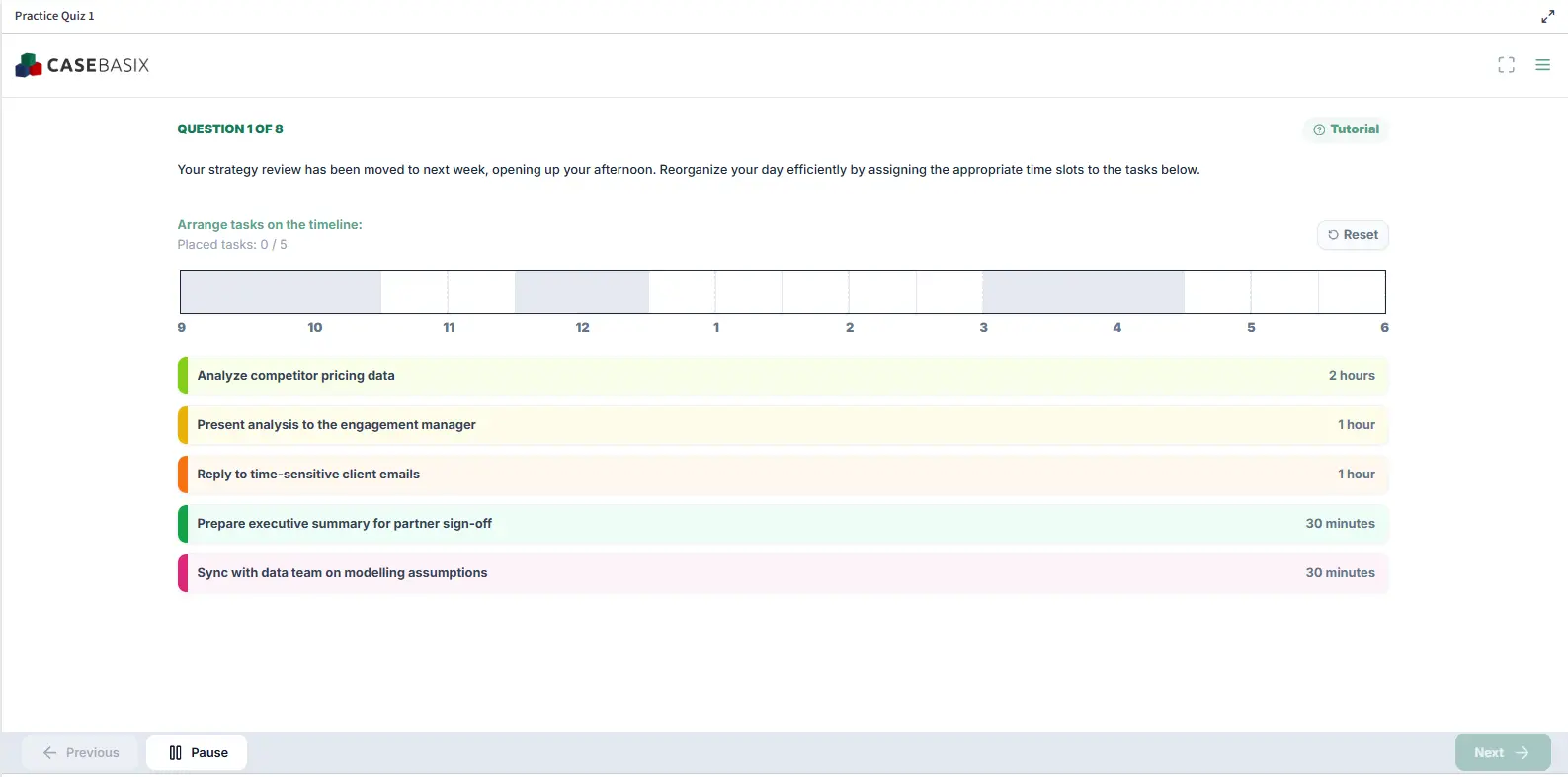
Time reallocation questions show a consultant schedule and a set of tasks that must fit into open windows. You may need to account for cancelled meetings, task durations, due times, and priorities.
Start by marking fixed meetings and open blocks. Then place tasks based on duration and urgency. In many questions, client-facing or time-sensitive work should be considered before internal cleanup work, but only when the question context supports that priority.
Scheduling logic questions
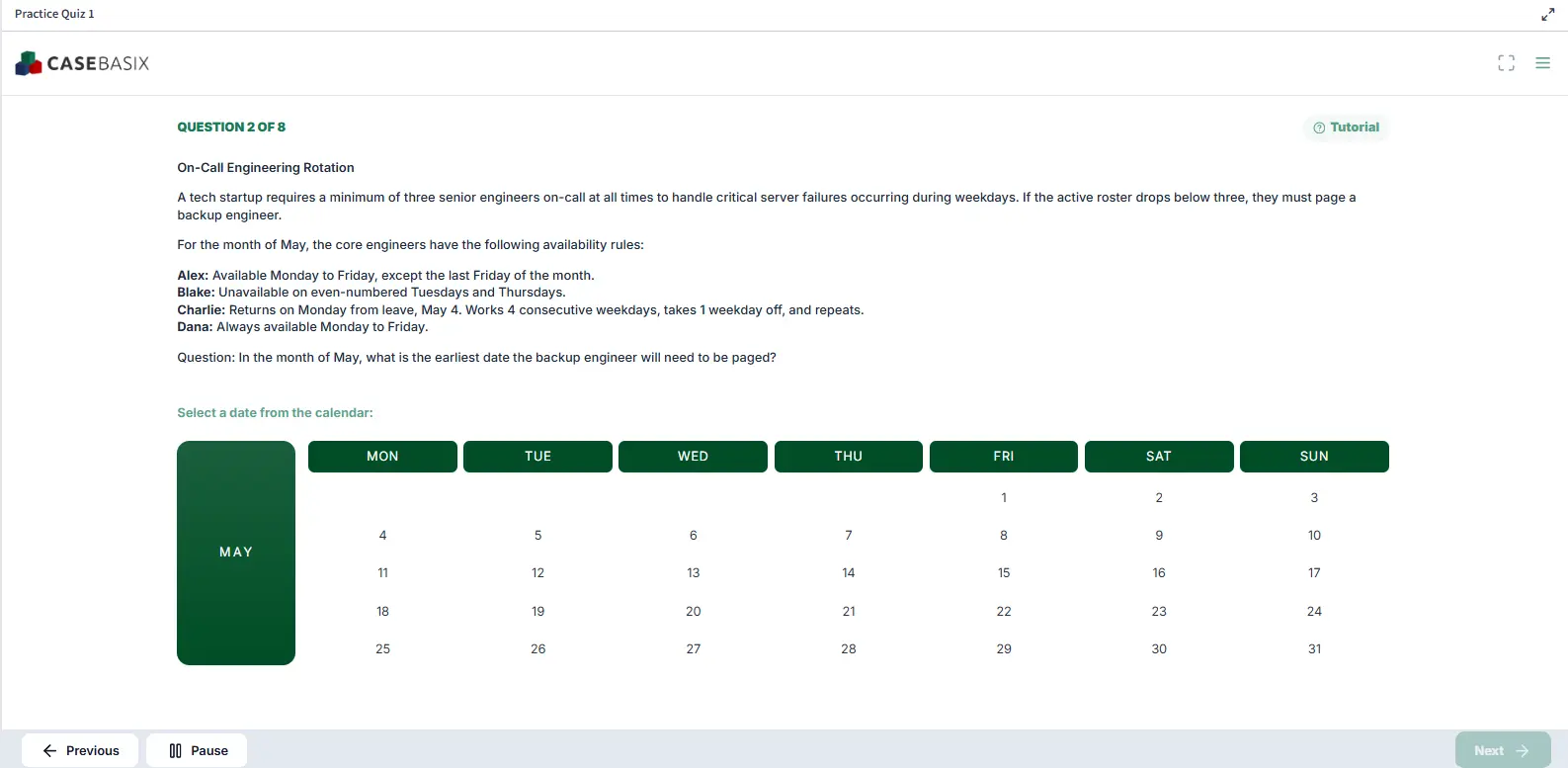
Scheduling logic questions give rules about days, availability, repeating patterns, or coverage thresholds. You may be asked to find the first date when a certain condition is met.
These are often time-consuming because one missed rule can change the answer. Use a compact grid. Track each constraint separately. Stop as soon as the earliest valid answer appears, rather than solving more days than necessary.
Quantitative reasoning questions
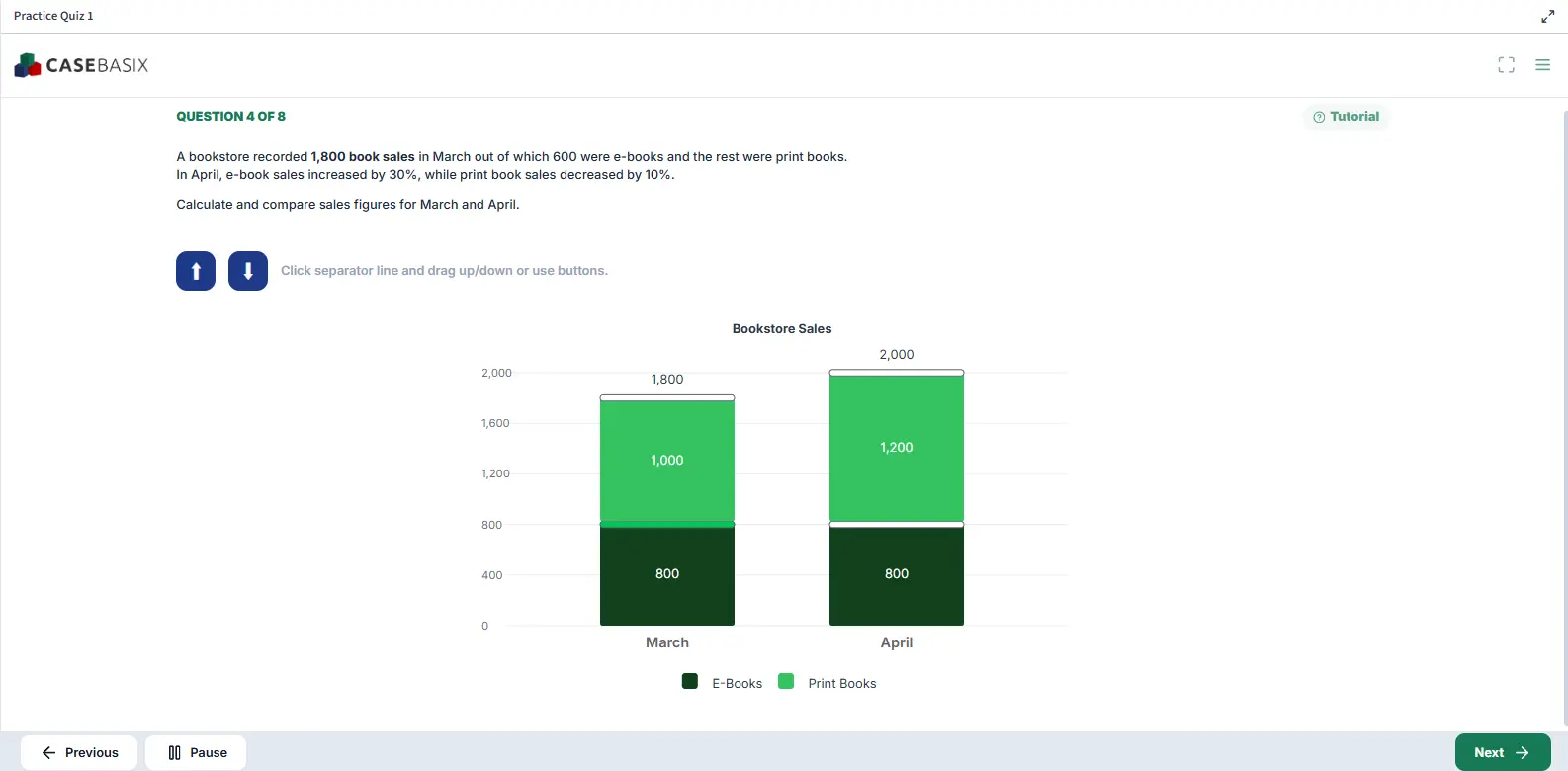
Quantitative reasoning questions ask for totals, percentages, proportions, comparisons, or simple changes over time. The math is usually manageable, but the wording can create traps.
Separate the starting number from the changed number before calculating. If one category rises and another falls, calculate each category separately before combining totals. This prevents a common error where candidates apply one percentage to the wrong base.
Visual pattern recognition questions
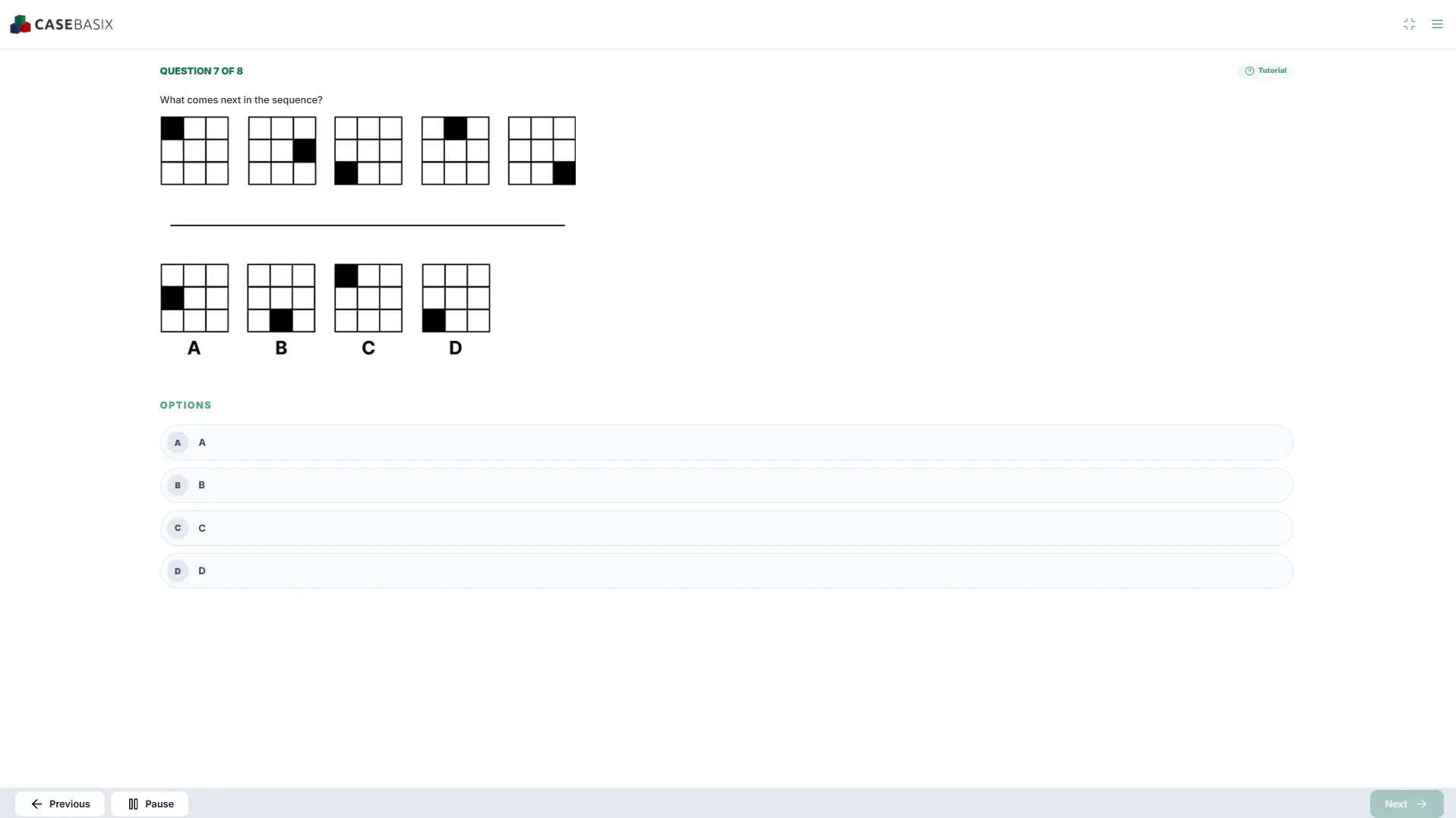
Visual pattern recognition questions show grids, shapes, colors, positions, or sequences that change step by step. Your task is to infer the rule and choose the next option.
Track one element at a time. A square may move by one rule while another shape changes by a different rule. Test your proposed pattern against every visible step before choosing an answer. If the pattern fails once, look for a simpler rule.
Across all numerical question types, use the same pacing rule. If you are stuck after about 60 seconds, make the best supported choice and move on. One uncertain answer is better than losing the entire section to the timer.
How Is the BCG CCA Scored and How Hard Is It?
The BCG CCA is moderately difficult because it combines untimed behavioral judgment with a fast numerical reasoning test. The personality sections reward consistency and self-awareness, while the numerical section rewards speed, organization, and careful reading more than complex calculations overall.
The behavioral sections do not work like a normal school exam. Many prompts do not have obvious right or wrong answers. Instead, your choices build a profile that can be compared with traits valued in consulting work. The exact scoring model is not public, so candidates should avoid trying to game it.
A practical way to think about the personality sections is to aim for professional consistency. You can show ambition without sounding reckless. You can show collaboration without sounding passive. You can show empathy without sounding unable to make hard decisions.
The numerical section is more direct because answers are usually correct or incorrect. The difficulty comes from time pressure, not advanced formulas. You have to identify what the question is asking, organize the information, and avoid calculation traps quickly.
Compared with the BCG Casey Chatbot, the CCA is earlier and more standardized. The Casey Chatbot is closer to a case-style assessment where you work through business information and solve a case problem. The CCA is shorter and mixes personality profiling with reasoning questions.
Compared with the BCG Pymetrics Test, the CCA is also different in format. Pymetrics is typically associated with game-based cognitive and emotional attribute testing. The CCA uses behavioral prompts and numerical reasoning questions, so your preparation should not be identical.
The hardest candidates to evaluate are often those who appear inconsistent. For example, a candidate who repeatedly says they prefer independent work but later says others would describe them as deeply team-oriented may create tension in the profile. The goal is not perfection. The goal is a believable, consultant-ready pattern.
How Should You Prepare for the BCG Consulting Career Assessment?
The best way to prepare for the BCG Consulting Career Assessment is to treat it as two separate tests: one behavioral profile and one timed reasoning challenge. Practice numerical questions under time pressure, plan consistent behavioral themes, and complete the test in a quiet, uninterrupted setting.
Start with the behavioral side. Before the test, write down the professional qualities you genuinely want to show. Strong consulting candidates usually demonstrate structured problem solving, collaboration, ownership, adaptability, communication, resilience, and sound judgment. Do not memorize scripted answers. Use these qualities as anchors so your responses stay coherent.
Then prepare for numerical reasoning. Practice short drills that force you to read a prompt, extract constraints, and answer within 90 seconds. The goal is not to learn advanced math. The goal is to make basic reasoning fast and clean.
Use this preparation checklist before starting the assessment.
- Block at least 45 minutes, even if the test itself takes about 30 minutes.
- Use a quiet room with stable internet and no expected interruptions.
- Keep a calculator, notepad, and pen beside you before opening the link.
- Practice schedule grids, percentage changes, totals, and simple visual patterns.
- Decide on your behavioral anchors, then answer honestly and consistently.
- Read each numerical question carefully before calculating.
- Move on if a question is taking too long.
If you only have one day to prepare, do not try to learn everything. Spend 30 minutes understanding the format, 45 minutes practicing timed numerical questions, and 15 minutes reflecting on your work style. Then rest before taking the test. Fatigue makes both behavioral consistency and numerical accuracy worse.
Frequently Asked Questions About the BCG CCA
Q: What is the BCG Consulting Career Assessment?
A: The BCG Consulting Career Assessment is an online screening test that evaluates
work style, behavioral tendencies, and numerical reasoning before later
interview stages.
Q: How long does the BCG CCA take?
A: The assessment
takes about 30 minutes. Candidates may receive a limited completion window
after the invitation email, often around 24 hours.
Q: How many sections are in the BCG CCA?
A: The 2026
format includes three sections: a 76 prompt personality test, an 8 question
numerical reasoning section, and a 15 prompt personality test.
Q: Is the BCG CCA timed?
A: Only the numerical
reasoning section is timed. It has 8 questions in 12 minutes, which gives about
90 seconds per question.
Q: Can I use a calculator on the BCG CCA?
A: Calculator use is allowed in the numerical section. You should also keep a
notepad nearby for schedules, constraints, and quick calculations.
Q: Is there a video component in the BCG CCA?
A: No.
The BCG CCA does not require a camera or recorded video response.
Q: Can I go back after answering a numerical
question?
A: In the numerical section, you may not be able to return after
submitting an answer and moving forward. Treat each answer as final before
advancing.
Q: How should I prepare for the personality
sections?
A: Reflect on your real professional style and answer consistently.
Avoid trying to appear perfect. Strong answers should be believable, balanced,
and aligned with consultant behaviors.
Q: How should I prepare for the numerical
reasoning section?
A: Practice reading short prompts under time pressure. Focus on
schedules, percentages, totals, simple comparisons, and visual patterns. Build
speed without sacrificing careful reading.
Q: What happens after the BCG CCA?
A: If your
performance meets the required benchmark, you may move to later stages such as
the BCG online case, live case interview, and final round interviews. The exact
process depends on the role and recruiting cycle.
Conclusion: The BCG Consulting Career Assessment is short, but it matters. Treat it as a real screening step, not an administrative form. The strongest preparation combines honest behavioral consistency with focused numerical practice. If you understand the BCG CCA format, manage the timer, and answer with a coherent professional profile, you give yourself a better chance of moving forward in the BCG hiring process.



